
Fort Washington City Directory Shelves
No continuous annual city directory exists for Fort Washington itself. The trail is regional and county-based instead. That means searching title, publisher, year, and coverage separately each time. One suburban edition may carry a Fort Washington address under its own name, while the same streets land under Oxon Hill, Laurel, Prince George's County, or a Washington suburban label in another. The reason is structural: Fort Washington is an unincorporated CDP, so there is no municipal clerk and no city-produced volume to anchor a series.
| Collection | Documented years | Where held | Access |
|---|---|---|---|
| Prince George's County Maryland Directory | 1878 | Historical Society history-links lead | Locate its page and record the image or call number before relying on it |
| Nelson's Suburban Directory | 1912-13, 1918 citation, 1923 citation | Historic-property citations and regional repositories | Check each issue for Fort Washington inclusion |
| Polk's Washington & Suburban Directory | 1930-31 | Prince George's County Genealogical Society | Cataloged library item, call number F0179.3.A18 |
| Polk's Laurel city directory | 1962 | Maryland State Archives catalog | Nearby-place lead, not verified Fort Washington coverage |
| LOC city and reverse directories | City holdings mainly 1861-1960; reverse inventory through 2005 | Library of Congress guides and catalog | Scans, requests, and library database routes vary by title |
Expect gaps, and do not read too much into them. The Library of Congress notes that annual directory series can skip years. They can skip several at a stretch. No edition promises that every Fort Washington address appears. A missing name is a cue, not a dead end. Check a different title, a neighboring locality, and the next year on the shelf. Note: Record the title page, year, publisher, page number, and locality label. Do this before joining any directory entry to another source.
Fort Washington Directory Research Room
Directory work in this area starts at the Prince George's Room inside the Hyattsville Branch. The collection does not circulate. Its holdings include newspaper microfilm, Sanborn maps, historic court proceedings, assessment books, and miscellaneous state records. Reader access covers both microfilm and microfiche. Staff can pull reels and guide the local-history consultation process. On site, Ancestry Library Edition opens census schedules and city directories. HeritageQuest adds a family-history route under the library's access conditions. Before requesting an item, review the Prince George's Room collection page. That page shows what the room holds.
The posted schedule runs Monday 10-6, Tuesday and Wednesday 12-8, Thursday and Friday 10-6, Saturday 10-5, and Sunday 1-5. Holiday and branch availability shift, so confirm before visiting. Come prepared. Bring the surname, likely street spellings, and a date range. Include any county or suburban titles already identified. A precise request helps staff pick the right reel or shelf item the first time. The Fort Washington city directory image on the page shows the library's local-history entry point. It also shows the kinds of material that turn a bare name into a real lead.
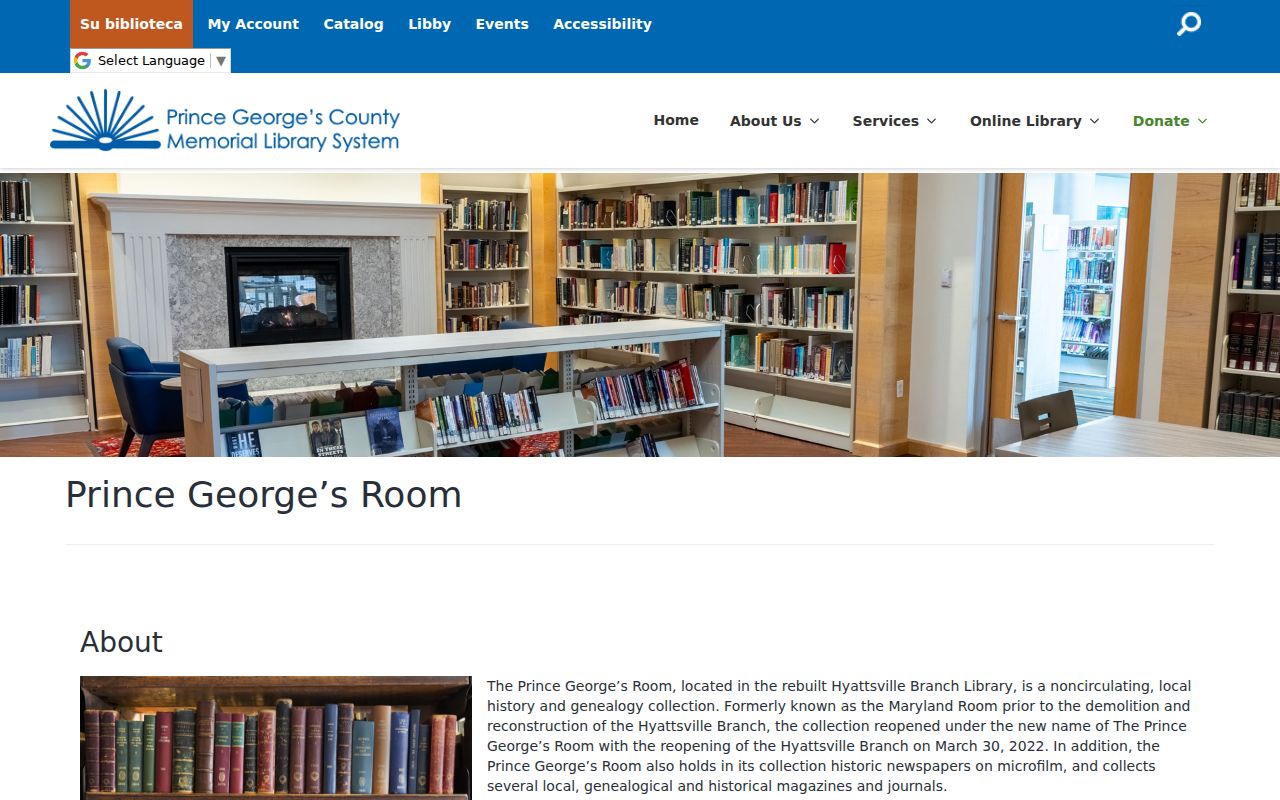
Newspaper, map, assessment, and photo holdings give the room its testing power. They can show whether a directory address refers to the same Fort Washington place that later records describe.
Read a Fort Washington City Directory Entry
Treat a city directory entry as a dated printed observation, not an identity file. It captures one moment. The Maryland Historical Trust's cited example joins a 1923 Nelson entry and a 1930-31 Polk entry to an older address and a modern property survey. Read the address, the year, and the bridge field together. For a Fort Washington result, transcribe exactly what the page prints. Punctuation, abbreviations, and older street forms all matter. The entry must be matched to a modern address with care.
| Name line | Copy surname and given name as printed, including initials and spelling variants. |
|---|---|
| Household notation | Capture a spouse in parentheses, a widow notation, relatives, or any other printed household clue. |
| Printed activity | Record the occupation field when the publisher supplied one, without treating it as a current fact. |
| Address line | Keep the house number, street abbreviation, and locality label exactly as printed. |
| Bridge field | Pair an old address with a deed, parcel, survey, or map only after the location has been checked. |
| Directory key | Photograph the volume's abbreviation key if one appears; a Fort Washington-specific key was not verified. |
- Criss-cross directory
- A directory arranged by street and number so a known address can lead to a printed name.
- Householder index
- A name list centered on a household contact, which may omit other people at the same address.
- Abbreviation key
- The publisher's legend for shortened terms and marks. Its meaning belongs to that volume, not every directory.
A name at an address in one edition is a lead. It establishes neither ownership, nor every person in the home, nor a continuous residence between editions.
Fort Washington City Directory Gaps
A local shelf can fall short. The Library of Congress city-directory guide helps locate the right kind of volume. The core historical holdings span many cities and counties, chiefly from 1861 through 1960. Coverage is title-specific, though. The separate United States Telephone Directory Collection covers Maryland and many twentieth-century reels. Some material sits online. The rest requires a request or a library route.
Search by place and date rather than assuming any digital run is complete. The Library of Congress guide shows how large the collection runs. That discipline matters. The Fort Washington city directories image on the page links to that collection guidance.
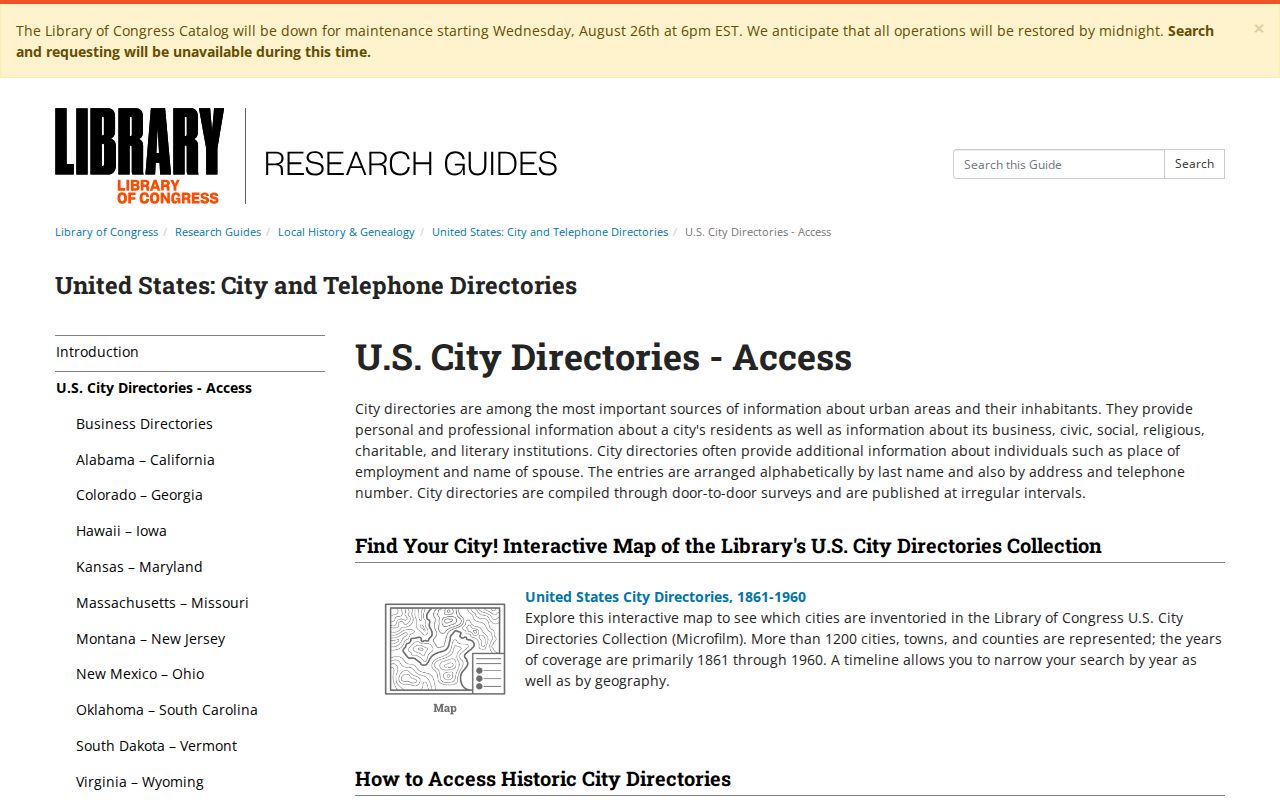
Use a catalog result to identify one specific volume. Confirm its publisher and geographic reach before calling it a Fort Washington source. For a known old address, a reverse or criss-cross volume often beats a name list. The Library of Congress inventory lists locality-specific reverse directories from 1930 to 2005. None covers Fort Washington alone. Give locality, state, and year in any request. Note: A nearby-town title can be the correct shelf lead, but only a page-level check confirms the Fort Washington address.
Fort Washington Directory Year Markers
The known directory dates form a working timeline rather than an unbroken series. Use them to plan which address form and companion records fit a given edition. Treat the markers as anchors. Years between them call for a catalog check, not an assumption.
| 1878 | Prince George's County Maryland Directory provides a county-wide lead. |
|---|---|
| 1912-13 | Nelson's Suburban Directory is documented in regional historical references. |
| 1918 and 1923 | Historic citations preserve Nelson references that may support an address bridge. |
| 1930-31 | Polk's Washington & Suburban Directory is cataloged by the county genealogical society. |
| 1962 | Polk's Laurel directory is a Maryland State Archives catalog lead for nearby-place research. |
Two county events can break a simple modern-number search. The 1962 addressing project reset numbers county-wide. A 1973 announcement brought address-number and street-name changes to Fort Washington. Keep the old road name and number in your notes. A deed, plat, or parcel description then makes the bridge.
Trace Fort Washington City Directories
City directories read like a trail of dated clues. Start from the clearest name or street address you have, and work outward from there. Keep a short research log. Spelling, street forms, and locality labels all shift between directory editions. That drift can hide the same household behind three different entries. Federal census schedules pair well with this. They add household relationships and ages that a street directory alone cannot show. Only remember that 1950 stands as the latest ordinary public decennial census. Later schedules are not on the ordinary release schedule.
- Locate the earliest verified directory title that plausibly covers the Fort Washington address or nearby locality.
- Transcribe the full entry and its printed abbreviation key, then note the page and year.
- Search the next available edition for the same spelling, a variant, and the prior street address.
- Use a criss-cross section when available to test the address and nearby printed households.
- Pair the resulting years with the public 1910, 1920, 1930, 1940, or 1950 census schedules.
- Check a deed, obituary, probate file, church record, cemetery record, or newspaper item before identifying two same-named people as one person.
Names vanish from directories for many reasons. A move, a death, a changed listing style, or a gap in the volume can all explain it. The record does not pick one. The Fort Washington previous residents record trail tests a household lead against one address using deeds and parcel references.
Fort Washington Historical Files
The Frederick S. DeMarr Library of County History sits in the Greenbelt Library's lower level. Its collection runs to roughly 6,000 books. Maps, archival photographs, journals, newspapers, person and place files, and Archives of Maryland materials fill the shelves alongside them. Public use is welcome. Weekday research works by appointment, and current Saturday hours should be confirmed before a visit. The yearbooks span 1930 through 2006. They help when a directory gives only an initial. A property-research bibliography from the Historical Society joins deeds, plats, assessments, newspapers, and local files. It proves valuable where a plat index names Fort Washington Forest, Fort Washington Local Park, or Fort Washington Methodist Church instead of a familiar street number. The DeMarr Library's holdings add a source-backed route.
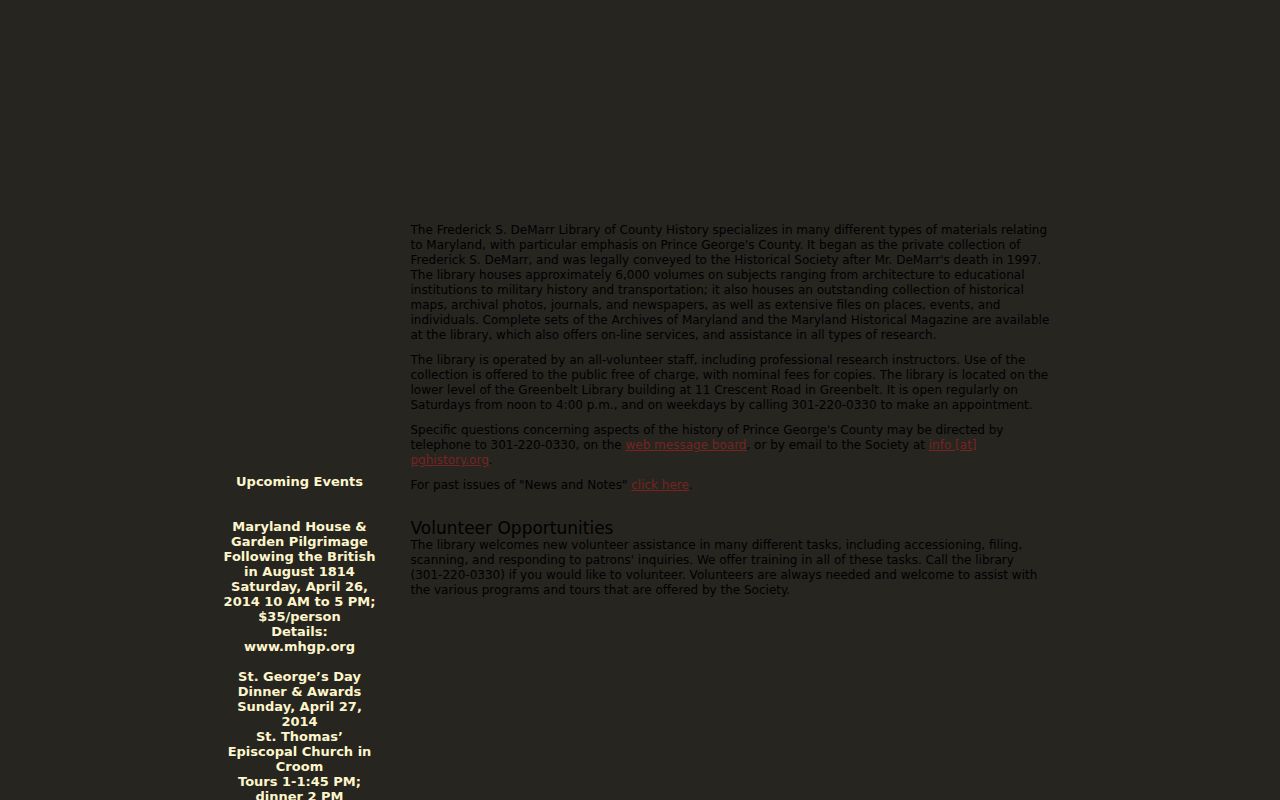
Maps, yearbooks, and photographs carry context directory lines lack.
Fort Washington City Directory Access
Match the access channel to the record. Online guides and catalogs help identify the right title. Selected scans may sit in the Library of Congress or a library database. Local repositories supply reels, books, and staff assistance. The Maryland State Archives supports county land, probate, assessment, tax, election, and court series. The National Archives at College Park route supports federal census and map work. Libraries and private societies are not county MPIA custodians. When you contact a repository, give the exact surname spelling, year, title, nearby locality, and old address if known. Ask for the call number, reel, and copy policy. A focused request beats a broad one. It is far more likely to find a usable city directory entry than a sweep for everyone who lived in Fort Washington. Note: Keep a source note beside every transcription so later address changes and spelling variants can be checked without guessing.