
Fort Washington Name Record Sources
Fort Washington sits in southern Prince George's County as an unincorporated Census-designated place. So no city hall keeps its own rolls. Every name search runs through county and state systems. Start by asking what each record can actually prove. A Maryland voter match supports current registration when the identity fields line up. A parcel card names an owner and the tax-notice mailing address. The recorded deed, in turn, lists the transaction parties. Court and probate indexes hand you case or estate leads. No single source, though, can confirm that two same-name people are one and the same.
| Record source | What it can confirm | Fort Washington route | Access |
|---|---|---|---|
| Parcel card | Owner, tax mailing address, premises and deed reference | Maryland SDAT Real Property Data Search | Free address, account, map or parcel search |
| Registration match | Limited current voter and polling information | Maryland Voter Lookup | Free with required identity fields |
| Public case index | Case number, parties, status and docket events | Maryland Judiciary Case Search & Record Portal | Free index; clerk copies differ |
| Estate index | Estate number, representative, attorney and filing lead | Prince George’s County Register of Wills | Basic information is public; papers may be limited |
| Vital and license sources | Event or public credential clues | Maryland Department of Health, Archives and state boards | Eligibility and source rules apply |
Let the starting point shape the route. A known parcel points to the address method. A bare name points to court, estate, business, or license records. For older household questions, the historical volumes on the Fort Washington city directory page bridge the gap better than any current portal can. Treat today's database as a snapshot of today, not of the past.
Fort Washington Voter Lookup Fields
The state voter form verifies one person at a time. It is not a browseable list of everyone in a ZIP code. You enter a first and last name. It also asks for a full birth date and a five-digit residential ZIP. Street number and middle initial help separate common names. Maryland suggests trying a former ZIP after a recent move. It also suggests a former name after a legal name change. Updates run daily. Still, an online or MVA change can take up to three weeks to show up. The Maryland Voter Lookup displays the required identification fields before it returns any match.
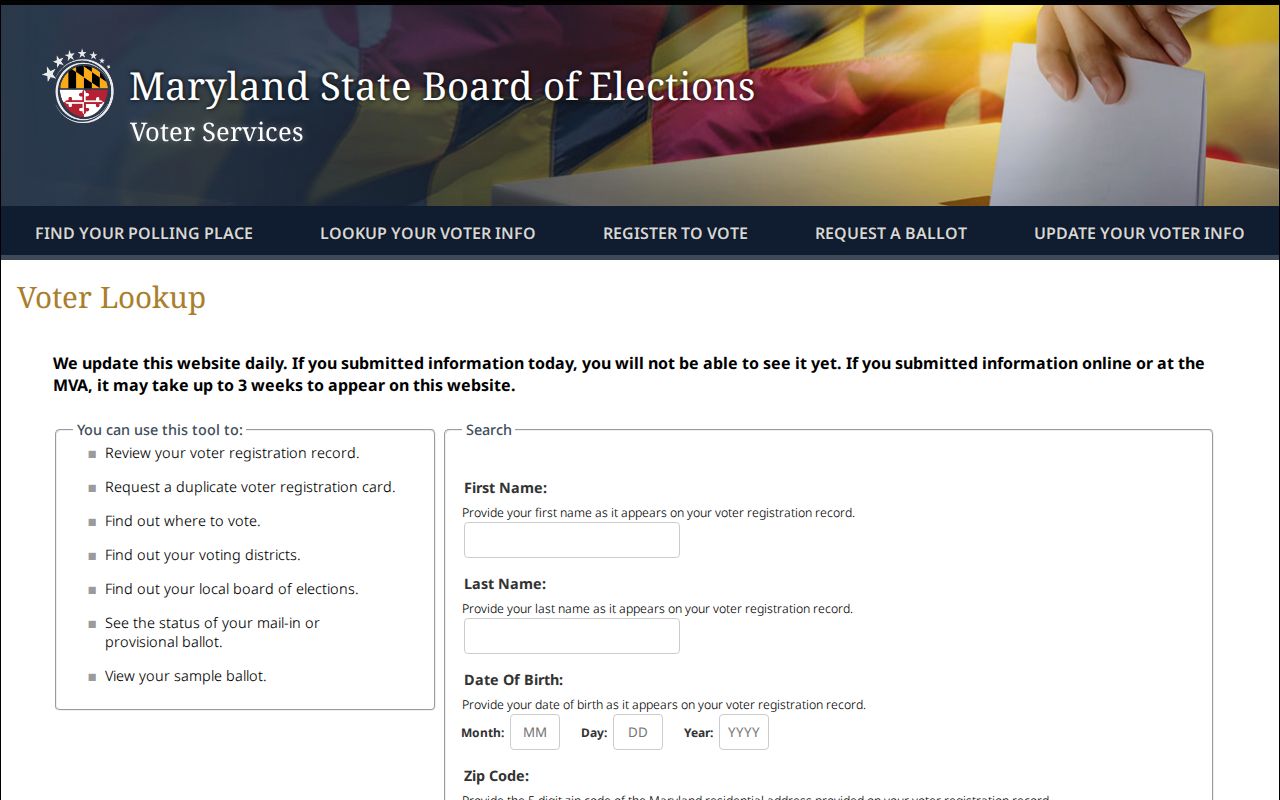
That field set shows why a name alone cannot power a Fort Washington resident lookup. The tool demands specifics before it gives anything back. What the public receives is limited current registration information. It does not expose a phone number, email, full date of birth, identification number, or any protected voter data, and should never be described as if it does.
| Lookup field | How it narrows a match |
|---|---|
| First and last name | Required spelling match, including hyphens or spaces where used |
| Date of birth | Required month, day and four-digit year |
| ZIP code | Required five-digit Maryland residential ZIP |
| Street number | Useful additional address detail, including allowed letters or punctuation |
| Middle initial | Optional disambiguator for a common name |
Note: Election Law and an electoral-use oath govern any voter-file product, so it is no substitute for a personal name search.
Fort Washington Case Search Checks
Once a name is narrowed, the Maryland Judiciary Case Search & Record Portal adds a second record type. The public party search lets you choose person or business. Fill in first, middle, and last name. You can filter by court, location, case type, or filing date. Partial last names follow the official percent-sign method. The portal's exact-name default can hide a variant spelling. A result list stops at 500 entries. Add a first name, court, case type, or date range before calling a search a dead end.
Treat any public case result as a docket lead, not certified proof of identity. Write down the case number, court, party role, filing date, status, and visible event labels. The original District or Circuit Court clerk can supply the document or a certified copy when it matters. Maryland's portal changed in 2026. Confirm the current acceptance and filter screens each time you search.
| Visible item | Why to preserve it |
|---|---|
| Case number and court | Direct the request to the correct custodian |
| Party type and name form | Shows whether the hit is a person or business and how the name was indexed |
| Filing date and case type | Place a match in the correct time period |
| Status and docket events | Describe the public index, not every document in the file |
Verify a Fort Washington Resident
One practical verification task tests whether a named person ties to a known parcel. It makes no claim that the person lives there. Begin with the physical address. Then compare the owner and deed trail against an independent record carrying its own date. SDAT offers no owner-name search. Its methods are street address, property account identifier, map or parcel, and sales. An owner shown after an address result may list a different tax-mailing address. That is normal, and you should label it as such.
- Confirm the street number and road spelling with USPS or PGAtlas, then retrieve the SDAT parcel card by address, account, map, or parcel.
- Save the premises address, owner name, mailing address, account or PAN, legal description, deed book and page, and retrieval date.
- Search the deed reference in Maryland Land Records and compare the grantor, grantee, recording date, and legal description.
- Use a separate dated record, such as a voter match supplied by the person, a probate index, court docket, newspaper notice, or board license result. Stop if the facts do not bridge the names.
- Docket
- A court’s running index of a case and its recorded events. It is not automatically the full case file.
- Index and image
- An index points to a record. An image is the scanned document, which can have account, access, fee, or redaction rules.
- Certified copy
- A custodian-issued copy that carries the office’s certification. It is requested from the original clerk or other record holder.
- Situs address
- The physical parcel location, distinct from an owner’s tax mailing address or a deed’s legal description.
Fort Washington Estate and Adoption Paths
Heir questions belong with the Register of Wills, not a general name search. Estate Search narrows by decedent first, middle, and last name. It also narrows by county, estate number, status or type, filing date, and party type. The public docket can surface a personal representative, attorney, or interested-person lead. Estate papers and sensitive details follow the Register's own access process. An address printed in a notice is not a current address.
Birth-family research ends at a different door. Maryland Department of Human Services Adoption Search Contact and Reunion Services works through the Mutual Consent Voluntary Adoption Registry. Where fitting, it also works through a trained Confidential Intermediary. Eligible adult adoptees, birth parents, and birth siblings may seek mutual-consent contact. Adoption court papers have been sealed since 1947. A person may decline contact. Maryland says its program is free. A private intermediary may charge under a service agreement, though.
Use the record’s purpose. An estate docket can lead to a representative, while the Maryland adoption process protects sealed records and mutual consent.
Fort Washington Resident Lookup Limits
Maryland opens broad record categories, but not every personal detail inside them. Birth records stay closed for 100 years. Death records stay closed for 10 years. Both limits come from State Government §9-1015. Certified vital copies also carry their own eligibility, identification, and fee rules. So an open index does not always mean an open copy. Court records can omit juvenile, adoption, sealed, expunged, shielded, or confidential material. Maryland's fingerprint-supported criminal-history information is not a public name-search product. Motor-vehicle personal information is restricted.
Voter records have their own limits. Election Law §§3-505 and 3-506, plus COMAR rules, protect personal identification numbers and sensitive fields. Maryland Safe at Home participants use a legal substitute address. Public bodies must shield that program's address information. Never infer a protected location from gaps across sources. Never use a past address to defeat a court order, seal, shielding rule, or adoption process.
Lawful personal use. Use a Fort Washington resident lookup for personal, lawful research such as family history or an estate matter. Do not use records to stalk, harass, intimidate, or harm anyone.
Fort Washington Record Correction Route
Fix a mismatch at the source. Corrections belong with the office that created the record. Take a parcel-card issue to the SDAT assessment office. Registration records go to the Board of Elections. A court index question belongs with the clerk. Estate material goes to the Register of Wills. A vital-record issue belongs with the Division of Vital Records or Maryland State Archives. Business or license filings go to the relevant board. Maryland Judiciary routes Case Search correction requests back to the original court.
An existing county record may not be online. Use the Maryland Public Information Act request route for the responsible agency. Name the record class, person, parcel, case number, date range, indexes, and attachments. That detail helps staff find what exists. Prince George's County guidance allows up to 30 days to respond. It may charge after the first two hours of search, preparation, and review. An MPIA request still cannot force an agency to create a new report. It also cannot bypass court, voter, vital, adoption, or confidentiality restrictions.
Note: Preserve a source date and exact name spelling with every result, because a no-result screen is not proof that a person never had a record.
Fort Washington Resident Lookup Library Leads
A current source cannot always settle a same-name puzzle. A historical source can supply the time bridge. The Prince George's Room at PGCMLS holds newspaper microfilm, historic court proceedings, assessment books, and Sanborn maps. It also holds photographs of old houses and buildings. Its staff-assisted local-history collection can help locate a date, street variant, or household. It can also point to a nearby newspaper title. A death notice may run in the Sentinel, Post, Bowie Blade, or Laurel Leader. It may not sit under a modern Fort Washington label.
Search the date, surname, and name variants together. The Prince George's County Historical Society and genealogical society add family files, maps, yearbooks, and local-history books. They also add directory holdings. These sources can tie a person to a school, church, cemetery, neighborhood, or older address. A historical published entry, though, is not evidence of a present residence.